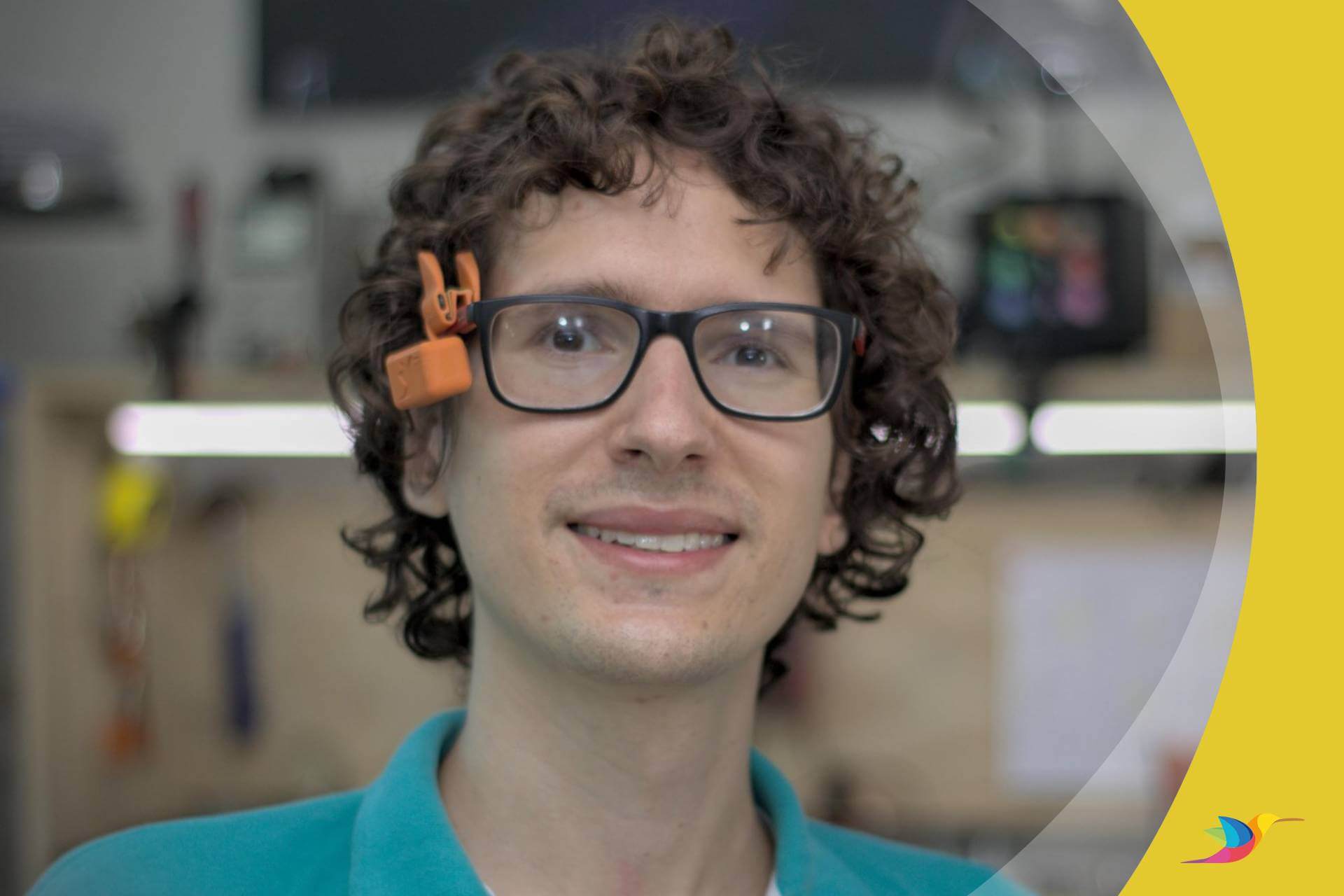
In the assistive technology landscape, the development of the Colibri head mouse represents not only a huge leap forward in terms of functionality, but also a symbol of inclusion and autonomy for people with disabilities. “Why Colibri? It’s for those who can’t interact with a touchscreen, keyboard, or conventional mouse, because they generally lack limb movement,” says Henrique Latorre, responsible for Colibri’s first flight and CTO of Colibri.
Developed based on a real need and driven by a vision of providing equitable access to technology, Colibri is more than just a head mouse; it’s an innovative solution that is making the world of technology more accessible in a very simple and uncomplicated way. “What the mouse needs to function fully: just head movement,” explains Henrique.
How the Colibri mouse took its first flight
The story behind the first flight of the Colibri mouse began with a simple need: to offer accessibility and autonomy to people with disabilities. The idea was born when the team met Mikael, who faced mobility challenges due to arthrogryposis, a condition affecting the joints. With his desire to play video games, Mikael found creative, but uncomfortable, ways to use his cell phone.
Observing this, his father conducted extensive research and eventually came across the Colibri team, which, until then, did not yet have hardware at this level. This experience motivated the entire team to develop a solution that was practical, lightweight, simple to use, and that could allow Mikael independence in his daily life while performing his favorite activity: playing games.
The first Colibri prototype was sent to Mikael, who quickly tested the product and sent it back, with the help of his father, providing valuable feedback. “The adaptation was surprisingly fast, but we saw that there were things to improve. It was a solution that served him very well, and we saw that it could serve more people, so we looked at which parameters we could improve to achieve that,” explains Henrique.
However, the development of Colibri technology didn’t stop with Mikael. Its continuous improvement involved a series of enhancements, each driving a more complete solution to reach an even wider range of people with disabilities, as Henrique explains: “We saw that we could make something compact, Bluetooth-enabled, and lighter. So we designed all the electronics, initially using 3D printing, until the launch of the first version of Colibri. That’s how we started offering it to those who sought us out, people with motor disabilities, looking for solutions to the most diverse problems imaginable.”
Continuous evolution towards perfection
Equipped with precise sensors and Bluetooth® connectivity, Colibri offers a fluid and efficient user experience. Furthermore, its rechargeable battery ensures long-lasting power, providing practicality and reliability.
Its advanced technology allows users to control electronic devices using intuitive head movements and blinking. It’s also possible to reconfigure the equipment so that, if blinking isn’t possible, the user can select other click options.
It’s also possible to adjust the cursor movement speed, in addition to various other adaptations so that Colibri suits the needs of each individual. “Especially for those with degenerative diseases or who are in the recovery process, this configurability is very good for allowing the person to keep the same device for longer.”
From the first prototypes to the final product, the team worked tirelessly to refine every aspect of Colibri. Through rigorous testing and valuable user feedback, starting with Mikael, Colibri evolved into the accessible and intuitive device it is today. “Today we have almost 40 configurable parameters based on the learning we’ve had with our subscribers. The model we offer makes the product more accessible and ensures that people will have their problems solved,” explained the developer.
Its simplified interface, ergonomic design, and variety of customizable features make it an indispensable tool for people with motor difficulties.