
Labor Day, celebrated on May 1st, is a date that recalls the historical struggles of workers for better working conditions and fundamental rights. In this context, it is important to reflect not only on the achievements already attained, but also on the challenges that still persist, especially regarding inclusion in the labor market.
By creating inclusive work environments, companies not only meet legal requirements, but also benefit from the diversity of skills, perspectives, and experiences that employees with disabilities bring. This promotes innovation, creativity, and productivity, as well as contributing to a more welcoming and empathetic organizational culture. Inclusion in the labor market not only transforms individual lives, but also strengthens the entire community.
A challenge of inclusion: the inadequacy of the Quota Law
In Brazil, companies with 100 or more employees are legally required to reserve 2% to 5% of their positions for people with disabilities, according to Article 93 of Law No. 8.213/91, known as the Quota Law. However, even after almost three decades, this legislation is still not fully implemented. People with disabilities continue to face numerous challenges in the job market.

Samara Andresa Del Monte, a journalist, is part of the International Society for Augmentative and Alternative Communication (ISAAC), a non-profit organization that aims to promote the development of Alternative Communication (AC) and improve the quality of life for people with disabilities and complex communication needs who experience significant difficulties communicating through speech. “We are increasingly becoming qualified, completing higher education courses, but the job market is not prepared to receive employees with any type of disability. It is still very difficult to find people with cerebral palsy, especially those who do not speak even when using alternative communication resources.”
Among the main problems with the Quota Law are the lack of specificity regarding the types and severity of disabilities, which leads to the predominance of hiring people with mild disabilities. Furthermore, many companies are not prepared to effectively welcome and integrate workers with disabilities, resulting in work environments that are not very inclusive or adapted. Samara also says that one of the biggest challenges faced by a person with a disability when trying to enter the job market is having accessibility and people who can assist them in companies. “Many people with disabilities only find opportunities to work from home and do not participate in the company’s daily routine.”

Challenges of informal work for people with disabilities.
A worrying statistic reveals that more than half (55.0%) of workers with disabilities are in the informal sector, with an average real income of R$1,860, compared to R$2,690 for those without disabilities. This means that these people are outside the formal labor system, without access to labor rights guaranteed by law, such as a formal employment contract, social security benefits, and unemployment insurance.
Furthermore, other data are also concerning: the illiteracy rate among people with disabilities was 19.5%, compared to 4.1% among those without disabilities. Only 25.6% of people with disabilities had completed high school, compared to 57.3% of those without disabilities.
This high rate of informality among workers with disabilities highlights the urgent need for public policies and private initiatives aimed at inclusion in the labor market. It is essential that there be a joint effort by society, companies, and governments to promote more accessible, inclusive, and equitable work environments, where all people have the opportunity to contribute and prosper.
The challenges faced by those who work in the market.


For Jamilla Fernanda Macedo Batista, a motivational speaker, the road ahead is still long and the challenges arduous. “Despite significant progress, we still face several barriers with prejudiced attitudes. For example: I am a wheelchair user, a graduate in Portuguese Literature from UFRN, I have motor and speech difficulties, and people ask my mother, as if I weren’t there, if I understand everything, if I can hear. They associate being in a wheelchair with being incapable of doing anything.”
“Companies need to commit to providing training to accommodate employees with disabilities according to their area of expertise and to provide adequate professional training in the workplace. There is a lack of adapted assistive technologies that are not available, limiting access to work. If all of society contributed through joint actions, we could build a fairer and more inclusive future for everyone,” Jamilla concludes.
How Colibri can be a tool for inclusion.

Liliane Cláudia, an accessibility specialist at Accenture, shared a bit about her experience in the technology world as a person with a disability, highlighting the challenges she faced throughout her career. “I’ve been working in the formal job market since 2019, with a signed contract, in design consulting. I started as a product designer, using design tools to prototype interfaces and create user experience flows, and I had many difficulties doing my job because the tools weren’t compatible with my assistive technologies.” Today, Liliane works directly with training on types of disabilities and providing guidance to design teams on how to apply and implement accessibility guidelines. “Colibri isn’t just in my professional work, in my day-to-day work, but also in my daily life,” Liliane explained.
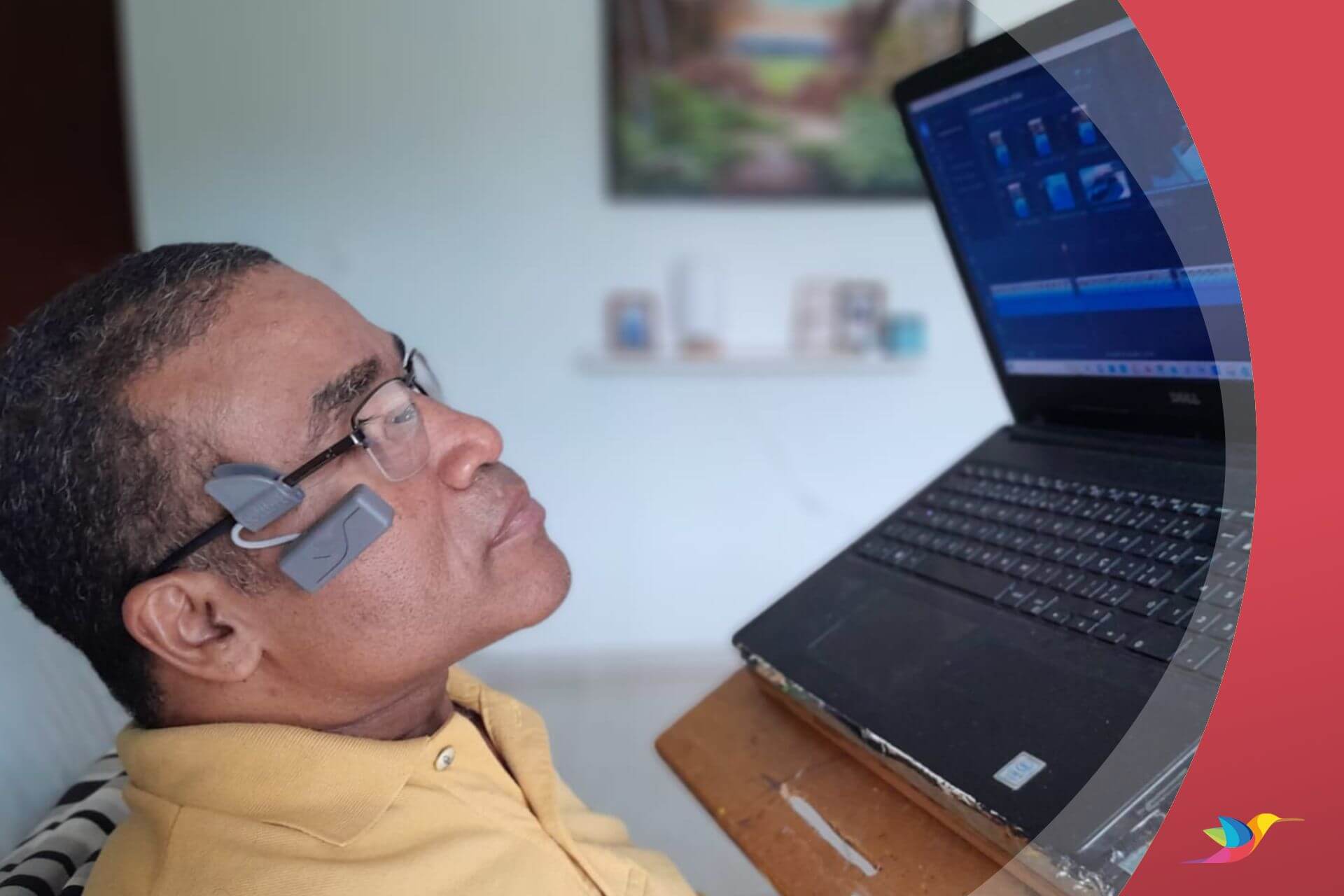
Colibri is an innovative head-mounted mouse that offers technological solutions to promote the inclusion of people with disabilities in various environments, including the workplace. With advanced accessibility features, Colibri makes computers and cell phones more accessible for people with motor disabilities, allowing for much greater user autonomy.
The head mouse allows for customization according to individual needs, offering an adapted and inclusive experience. With flexible configuration options, it’s possible to adjust the workspace according to each person’s preferences and abilities, ensuring their full participation and productivity.
It allows the user to adapt the cursor settings as they prefer, adjusting its speed and movement across the screen to best suit their purpose. For Liliane, for example, Colibri was very useful with its head movement. “I use Colibri a lot for the mobile interface, and if I didn’t have Colibri, I wouldn’t have this mobile access because I’ve already tested other assistive technologies, and since my head movement is more agile, I can configure the speed of the cursor control that Colibri puts on the screen for me. And I need this speed because I have a very agile neck movement. The other assistive technologies I’ve tried on mobile are slower; they don’t have the configuration or customization of the experience that’s best suited to my needs. So, with Colibri, I adapted very well to it because of the customization I can do with the cursor control.”

Marcelo Cunha, a quadriplegic since 1991 due to a diving accident, also uses Colibri in his successful career as a visual artist, speaker, advertiser, and writer. “Physical limitations haven’t prevented me from enjoying significant achievements. Throughout these accomplishments, the use of technology has been essential,” he said. “In this way, Colibri’s functionality, in addition to optimizing my time, has allowed me to enjoy undeniable ease in conducting my work and research. Through this freedom, I can access and promote broad interactivity on my social networks, thanks to the autonomy to edit and share my videos.”
By providing accessible and adapted tools, Colibri promotes inclusion in the workplace, creating equal opportunities for all people, regardless of their abilities or limitations. This contributes to a more diverse, inclusive, and welcoming work environment where everyone feels valued and respected.